
Loading...
Roden | SKU:
PKROD054
Sold out
29% off
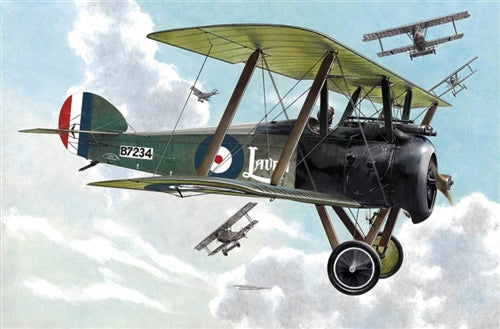
Roden Sopwith F.1 Camel Two-Seat Trainer — 1:72
£9.99
£13.99
Unit price
/
Unavailable
Tax included
Shipping calculated at checkout.
Roden Sopwith F.1 Camel Two-Seat Trainer — 1:72 will be backordered from our supplier. Delivery will take between 3-5 working days & orders will be despatched once completed.
Sign up to be the first to know when this product is back in stock!
Description
Description
Manufacturer and kit history
Roden is a Ukrainian manufacturer particularly well known for historically interesting aircraft from the First World War and interwar periods. The company's Camel range includes several related 1:72 kits, with catalogue numbers 051–054 covering different Camel configurations.
Kit 054 represents the comparatively unusual two-seat training version rather than the familiar single-seat combat Camel. The kit was added to specialist catalogues in 2006–08 and remains available through some model retailers.
The finished model is approximately 80 mm long, with a wingspan of roughly 118 mm. One current listing specifies 47 parts, supplied on three plastic frames with decals.
Kit contents
The Roden 054 kit contains the parts necessary to construct the two-seat training aircraft, including:
Fuselage halves
Upper and lower wings
Interplane and cabane struts
Two-seat cockpit arrangement
Dual-control cockpit details
Clerget rotary engine
Propeller
Landing gear
Tail assembly
Flying wires/structural details represented by the kit parts
Other airframe components
Decals
Assembly instructions
The kit is supplied unassembled and unpainted, with glue and paints requiring separate purchase.
The full-size Sopwith Camel
The Sopwith Camel was one of Britain's most important fighter aircraft of the First World War.
Designed by the Sopwith Aviation Company, it was developed as the successor to the highly successful Sopwith Pup. The prototype first flew in December 1916, with deliveries to frontline units beginning during 1917.
The aircraft was a compact wooden biplane with a powerful rotary engine and concentrated armament. Its distinctive raised forward fuselage, which housed the machine guns and fuel tank around the cockpit, gave rise to its famous “Camel” nickname.
The standard F.1 Camel
The standard Sopwith F.1 Camel was a single-seat fighter.
Typical aircraft were powered by a 130 hp Clerget 9B rotary engine, although other engines were installed during production.
The usual armament was two synchronised .303-inch Vickers machine guns mounted in front of the pilot.
Representative characteristics included:
Crew: 1
Engine: Clerget 9B, approximately 130 hp
Maximum speed: approximately 112 mph / 180 km/h for representative combat configurations
Wingspan: approximately 8.53 m
Length: approximately 5.7 m
Armament: normally 2 × .303-inch Vickers machine guns
Development of the two-seat trainer
The Camel was a highly effective fighter but was also notoriously demanding to fly.
Its concentrated mass and rotary-engine gyroscopic effects produced unusual handling characteristics. Poorly trained pilots could easily lose control, particularly during slow-speed manoeuvres.
Frontline units initially created improvised two-seat trainers by modifying combat aircraft. However, these conversions could have serious stability problems because the aircraft's centre of gravity was altered.
Sopwith subsequently developed a proper two-seat training version during 1918, incorporating structural changes specifically intended to make the aircraft suitable for instruction.
Changes to the trainer
The training aircraft differed substantially from the normal fighter.
Important changes included:
The standard F.1 Camel
A second cockpit
Dual controls
Removal of the normal fighter armament
Reduced fuel capacity
Revised cockpit arrangement
Changes intended to improve stability
Additional space for an instructor
The fuel tank was reduced because training flights generally lasted only around 10–15 minutes.
The result was a much more practical aircraft for teaching pilots how to handle the Camel.
Performance
The two-seat trainer was slower than the frontline fighter.
Published specifications for the trainer give:
Crew: 2
Engine: Clerget 9J
Power: approximately 130 hp
Maximum speed: approximately 148 km/h
Wingspan: 8.53 m
Length: 5.69 m
Wing area: approximately 21.5 m²
The exact specifications varied between individual aircraft and sources.
Training role
The Camel trainer's primary purpose was to allow pilots to become familiar with the handling characteristics of the Camel before being sent to operational units.
This was particularly important because the aircraft's reputation for difficult handling meant that simply transitioning directly from a basic trainer to a combat Camel could be dangerous.
The instructor occupied the second cockpit and had duplicated controls, allowing the trainee to learn the aircraft under supervision.
Combat history of the Camel
Although this particular version was a trainer rather than a frontline fighter, its parent aircraft had an extensive combat record.
The Camel became one of the most successful Allied fighters of the First World War.
It was employed for:
Air combat
Escort
Balloon attacks
Ground attack
Reconnaissance
Airfield attacks
Home Defence
Its concentrated mass and powerful rotary engine gave experienced pilots exceptional manoeuvrability.
Ground attack
The Camel was particularly effective during low-level operations late in the war.
Its machine guns could be used against ground targets, and the aircraft could carry bombs.
This made the Camel useful during the increasingly mobile fighting of 1918, when attacks on troop concentrations, transport and communications became important.
Home Defence and night fighting
Specialised Camels were also adapted for Home Defence and night interception.
Roden's catalogue includes the related Camel “Comic” kit 051, while kit 054 represents the training configuration.
The existence of these variants demonstrates how the basic Camel airframe was adapted for several different roles during the final years of the First World War.
Historical significance
The two-seat trainer is an interesting but often overlooked part of Camel history.
The famous image of the Camel is normally that of the heavily armed single-seat fighter, but training was essential to operating such a demanding aircraft safely.
The trainer therefore represents an important part of the RAF's developing system for converting pilots onto high-performance combat aircraft.
Payment & Security
Payment methods
Your payment information is processed securely. We do not store credit card details nor have access to your credit card information.